THE CHALLENGE In media production, data about projects, companies, and people is everywhere—but fragmented across hundreds of inconsistent websites. For Wercflow, we saw a huge opportunity: If we could automate the collection of this public data, users would land on the platform with pre-populated profiles and a rich, interconnected database—boosting immediate value, engagement, and retention. But traditional scraping wouldn’t cut it. Websites had dynamic content, inconsistent structures, and constant changes. We needed a system that could adapt, self-correct, and run continuously—without human intervention.
Company:
Wercflow
My Role:
Product Developer
Year:
2024
Techstack
Auto-GPT | GPT-4o | Playwright | Selenium (Chromium Headless) | Python | Azure Functions | Docker
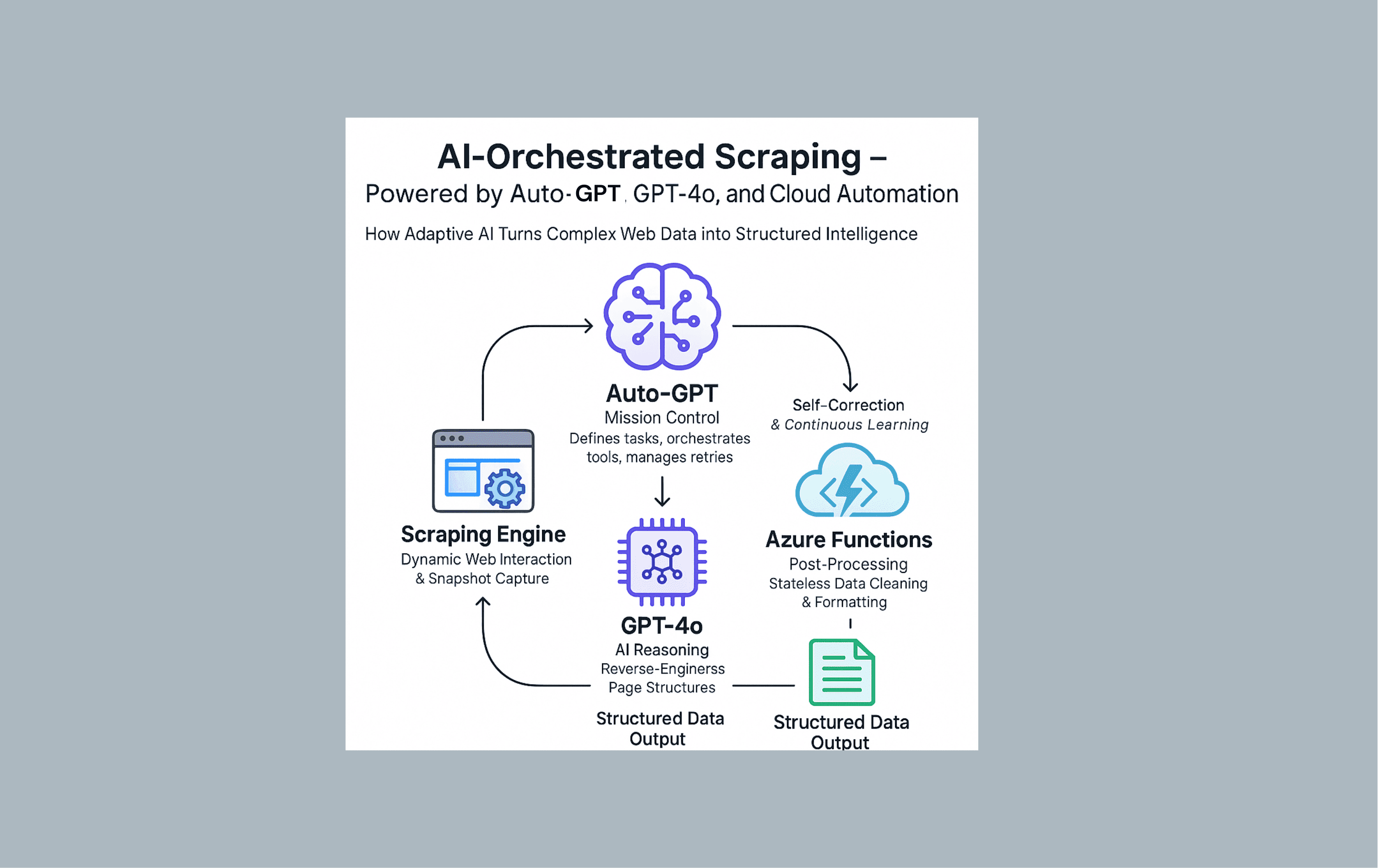
The Solution — AI-Powered, Mission-Driven Scraping Orchestrated by Auto-GPT
I designed a fully autonomous, AI-orchestrated scraping pipeline where:
Auto-GPT acted as the mission controller, dynamically handling scraping tasks.
GPT-4o provided intelligence to understand and reverse-engineer website structures.
The system learned, adapted, and improved—turning messy web data into clean, structured datasets ready for import.
1️⃣ Mission Control with Auto-GPT (Dockerized Environment)
Each scraping task started with Auto-GPT receiving a target URL and a defined data schema (e.g., company names, project titles, roles).
Auto-GPT broke down the mission:
“Navigate → Analyze → Extract → Validate → Prepare Data.”
It orchestrated all components from within a Docker container, allowing persistent, stateful execution.
2️⃣ Dynamic Web Interaction
Using Playwright and Selenium (headless Chromium), Auto-GPT:
Navigated complex websites.
Handled user interactions like clicks, scrolls, and pagination.
Captured full HTML snapshots and screenshots for AI analysis.

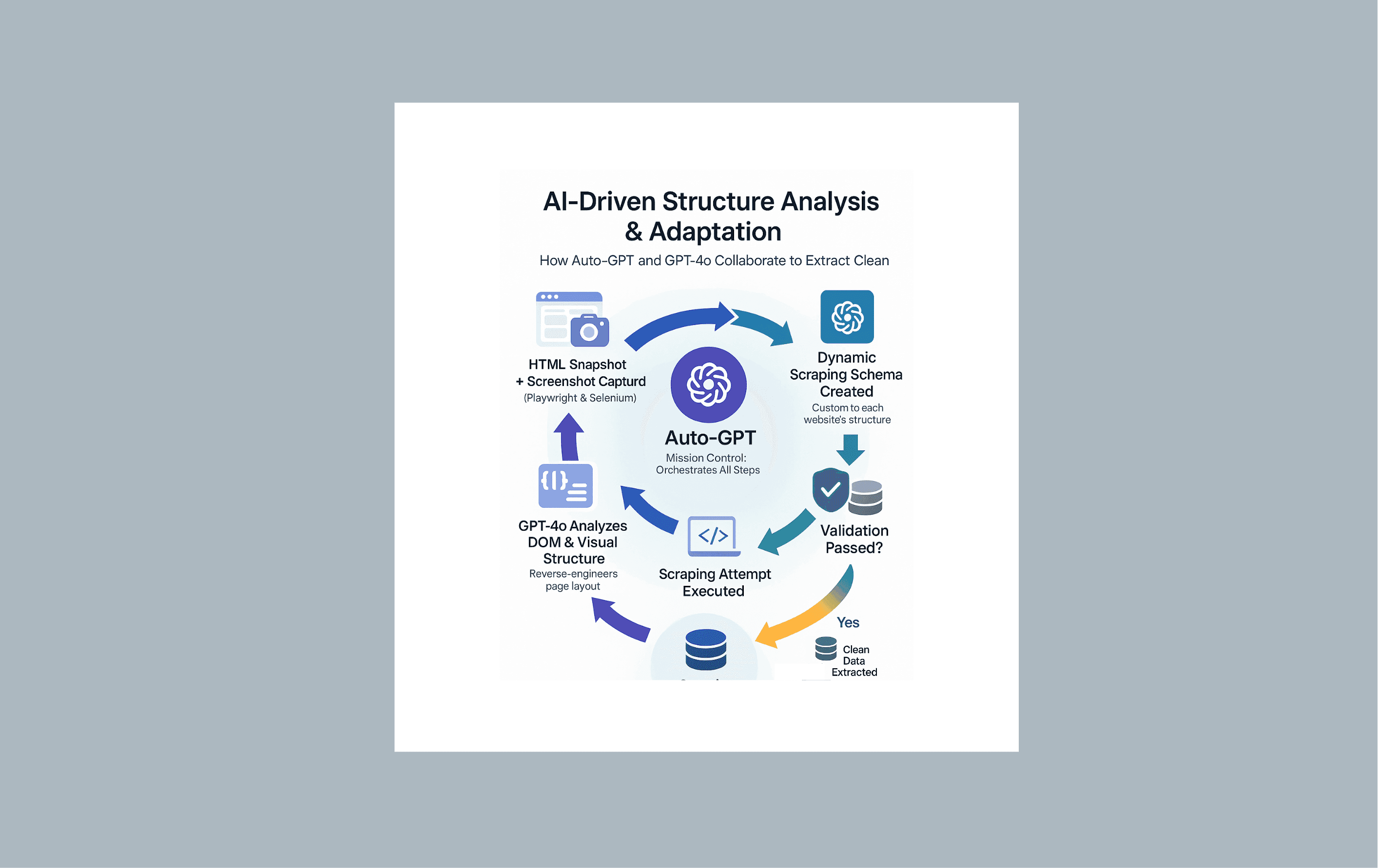
3️⃣ AI-Driven Structure Analysis & Adaptation
Auto-GPT sent captured data to GPT-4o, which:
Reverse-engineered the DOM structure based on visual and HTML data.
Generated dynamic scraping schemas tailored to each unique site.
Suggested alternative strategies when initial attempts failed.
This created a self-correcting loop—Auto-GPT iterated until it successfully extracted clean data.
4️⃣ Post-Processing & Validation (Azure Functions)
Once data was scraped:
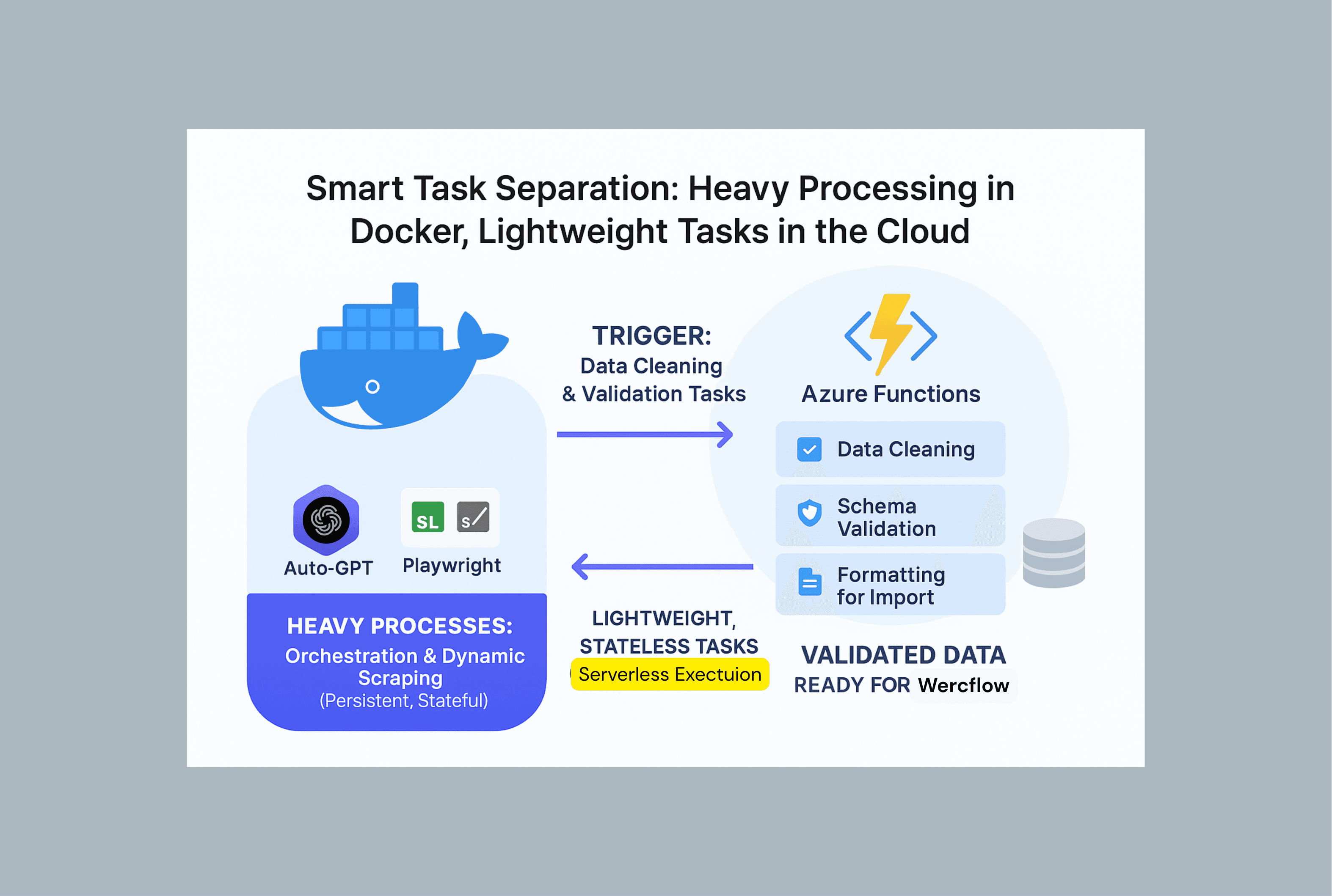
Auto-GPT triggered Azure Functions to handle:
Data cleaning.
Schema validation.
Formatting for Wercflow’s import pipeline.
This separation ensured lightweight, stateless tasks ran efficiently in the cloud, while heavier scraping logic stayed within Docker.
📊 The Impact
This wasn’t just automation—it was a smart, AI-driven system.
By leveraging Auto-GPT’s autonomous task management and GPT-4o’s reasoning capabilities, the scraper evolved beyond brittle scripts into a self-reinforcing data engine—capable of adapting to the unpredictable nature of the web.
The hybrid deployment—heavy processes in Docker, lightweight tasks in Azure Functions—ensured both power and efficiency.
Data Accuracy Rate | 97% |
Continuous Operation | 24/7 |
Cost Reductions | - 80% |