
A white-label AI operating system for community banks. 10 core banking and compliance systems unified behind a dual tool marketplace — one multi-year enterprise agreement cascading across hundreds of downstream institutions.
Company:
Global Fintech Platform
My Role:
AI Product Manager, Enterprise Solutions (Unframe AI)
Year:
2026
Techstack
Multi-Agent Orchestration · Core Banking Ledger APIs · MCP Architecture · Compliance Automation (BSA/AML) · Multi-Tenant Isolation · Salesforce · Plaid · DocuSign · ADP · QuickBooks · Visa · Mastercard · Stripe · Snowflake
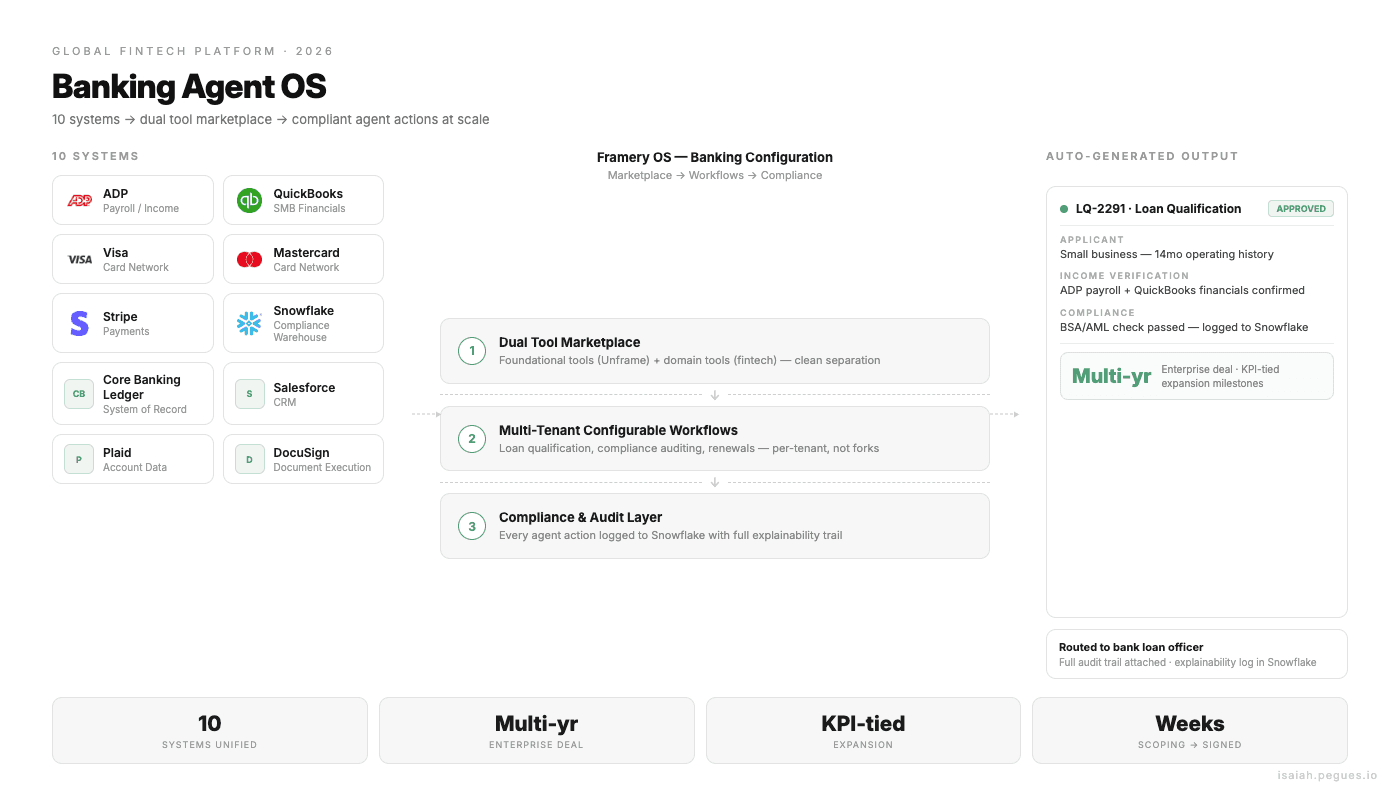
Community banks and credit unions were drowning in disconnected systems — core ledgers, Salesforce, Plaid, DocuSign, compliance tools — each requiring separate logins, manual reconciliation, and specialist knowledge no small IT team could maintain. AI vendors pitched replacements. None of them would fly with a 2-person IT department running a 1990s core ledger.
A global fintech platform serving these institutions saw the opening: build an AI operating system they could white-label and resell downstream. Every architecture decision would cascade across hundreds of bank and credit union tenants, each with different core systems, compliance postures, state regulatory requirements, and customer bases.
STEP 1 — Dual Tool Marketplace
Designed a two-layer marketplace: Unframe foundational agents (loan qualification, BSA/AML compliance audit, customer interaction routing, renewal processing) plus domain-specific tools the fintech client could layer on top. Community bank IT teams got a curated catalog — one integration point, not ten. The fintech client got a differentiated product they could package and sell downstream without rebuilding anything.
STEP 2 — Multi-Tenant, Per-Tenant-Configurable Architecture
Every community bank tenant gets identical foundational agents but with per-tenant configuration: their own core ledger endpoints, their own Plaid credentials, their own state compliance ruleset. Multi-tenant isolation at the data layer, shared infrastructure underneath. A config change at the platform layer propagates to all tenants — a regulatory update doesn't require 200 individual deployments.
STEP 3 — Compliance and Audit Layer
BSA/AML rules aren't optional for banks. Every agent action that touches a customer record or transaction was logged with a complete audit trail — who queried what, with what authority, what the agent surfaced, and what action followed. Compliance officers could reconstruct any agent decision from the audit log. Regulators saw a system that strengthened their documentation posture, not one that created new risk.
STEP 4 — Deal Structure and Compounding Expansion
Structured as a multi-year enterprise agreement with KPI-tied expansion milestones. Initial deployment covered the four core use cases. Each new community bank tenant onboarded by the fintech client automatically adds another node to the platform — the fintech's sales motion and our deployment model compound together. The more banks they sell, the more our platform proves out at scale.
RESULTS
Multi-year enterprise agreement with KPI-tied expansion milestones
4 core use cases live: loan qualification · compliance auditing · customer routing · renewal processing
10 banking, payment, and compliance systems unified behind one platform
Downstream reach: community banks and credit unions across the US (white-label)
Weeks from scoping to signed — architecture designed for hundreds of downstream tenants from day one
